How Do We Talk to Space?
Or, more precisely: how can two antennas, separated by billions of kilometers, exchange information as if they were next-door neighbors?
Everyday life gives us tiny hints at how fragile wireless communication really is. Wi-Fi struggles to reach the corner of your apartment. Radio collapses into static when your car enters a tunnel. Mobile signals vanish the moment you hike into the mountains. All of that happens on Earth — within a few kilometers of infrastructure.
Now stretch that problem into the cosmos. Imagine wanting to exchange data not across a city, but across hundreds of millions — or even billions — of kilometers. How do we actually talk to Mars rovers, space telescopes, and Voyager probes that have traveled beyond the solar system?
This is the hidden challenge of space exploration: communication across the void. Without it, astronauts, probes, and telescopes would be deaf and mute. Humanity’s great cosmic adventures — Apollo, Hubble, Perseverance, Webb — would be nothing more than silent launches into darkness.
The Physics of Space Signals
At first glance, the recipe seems simple: put an antenna on Earth, put one on the spacecraft, and exchange signals. But in practice, physics complicates everything.
- Earth rotates on its axis and orbits the Sun, meaning antennas on the ground constantly shift position relative to spacecraft.
- The atmosphere bends, scatters, and weakens radio waves — sometimes absorbing or reflecting them completely.
- Obstacles in space — planets, moons, or even dust clouds — can temporarily block signals.
- Thousands of spacecraft must share limited frequency bands without interfering with one another.
To deal with this, engineers rely on two fundamental principles of electromagnetic waves:
- Lower frequencies travel farther and resist obstacles better, but transfer data slowly.
- Higher frequencies allow massive data rates, but are fragile, easily blocked, and quickly weakened.
This trade-off, first quantified by Claude Shannon’s Shannon Capacity Theorem, shapes every decision in space communication. Every mission must balance range, reliability, and data speed.
From Apollo to Mars Rovers
In the 1960s, during the Apollo missions, astronauts communicated using the S-band (~2–3 GHz). That’s roughly the same spectrum we now use for Wi-Fi and Bluetooth. It was enough for:
- Telemetry (health and performance of the spacecraft)
- Two-way voice with mission control
- Grainy, black-and-white TV broadcasts of the Moon landing
It worked — but just barely.
Fast-forward to the 21st century. Missions like the James Webb Space Telescope (JWST) and the Perseverance rover need to send back far more complex data.
- JWST sits 1.5 million kilometers from Earth and beams down breathtaking images of the early universe, often in the range of hundreds of megapixels.
- Perseverance roams Mars, 225 million kilometers away, transmitting gigabytes of scientific data, videos, and sounds of the Martian surface.
How did we scale from scratchy Moon broadcasts to terabytes of cosmic data? The answer lies in one of humanity’s most underrated engineering feats: the Deep Space Network.
The Deep Space Network: Our Antennas to the Universe
Established in 1963, the Deep Space Network (DSN) is NASA’s global communication backbone. It was born from necessity: Earth rotates, meaning any single antenna would constantly lose sight of spacecraft. The solution was to place three stations roughly 120° apart in longitude, guaranteeing at least one always has a clear view.
Three DSN Locations
- Goldstone, California — in the Mojave Desert, isolated from interference.
- Madrid, Spain — hidden in a mountain valley, shielded from terrestrial radio noise.
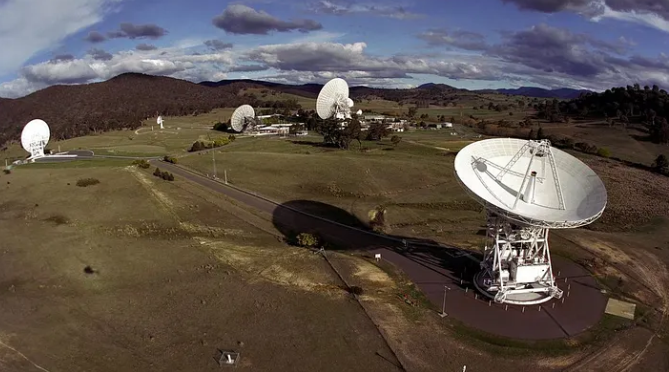
- Canberra, Australia — protected by mountains and a canyon, away from urban interference.
Together, these locations form a planetary-scale triangle that provides uninterrupted coverage of the solar system. If you’ve ever seen photos of enormous “satellite dishes” in remote areas, chances are you were looking at one of the DSN’s antennas.
Precision & Sensitivity
These antennas are marvels of precision. Take DSS-43 in Canberra:
- Diameter: 70 meters
- Aiming precision: 0.0038° (roughly the width of a human hair seen from 30 meters away)
- Power sensitivity: Able to detect signals weaker than 10⁻¹⁸ watts — essentially a whisper of a whisper
For context: Perseverance transmits with just 10 watts — about the same as a nightlight bulb. By the time the signal reaches Earth, most of it has vanished into noise. And yet, DSN antennas can still capture and decode it.
How Fast Can We Talk to Space?
Communication speed depends on frequency bands:
- 1960s Apollo missions: S-band (~2–3 GHz). Speeds: a few kbps — enough for voice and low-quality video.
- Modern missions: X-band (~8 GHz) and Ka-band (~32 GHz).
For example, the James Webb Telescope uses Ka-band to transmit at 28 Mbps — fast enough for Full HD video streaming. Each day, JWST sends about 60 GB of raw science data to Earth.
But reliability still matters. Spacecraft commands and telemetry usually stick to the lower S-band. It’s slower (around 40 kbps) but less prone to disruption.
Scheduling: The Cosmic Queue
Dozens of spacecraft compete for DSN time. To avoid chaos, NASA organizes communication through careful scheduling:
- Antenna Time: Each mission gets a slot with specific antennas.
- Frequency Division: Different spacecraft transmit on separate frequencies to avoid interference.
- MSPA-4: Up to four spacecraft can share a single antenna simultaneously using multiple frequency channels.
This careful orchestration ensures everyone from Mars rovers to probes at the edge of the solar system gets a fair chance to phone home.
The Voyager Miracle
Perhaps the most astonishing DSN achievement is its ongoing link with Voyager 2. Launched in 1977, it now drifts 21 billion kilometers from Earth.
- Transmit Power: 23 watts — less than many home lightbulbs.
- Signal Travel Time: ~20 hours one way.
- Data Rate: Just a few hundred bits per second — slower than a 1990s dial-up modem.
And yet, DSS-43 in Canberra still maintains contact. Nearly five decades later, Voyager continues whispering across interstellar space, sending humanity updates from beyond the solar system.
Why It Matters
The Deep Space Network rarely makes headlines, but it is the unsung backbone of exploration. Without it:
- Apollo 11 wouldn’t have spoken to Houston.
- Perseverance wouldn’t have shared its Martian selfies.
- James Webb wouldn’t have delivered its breathtaking cosmic images.
- Voyager 2 would be lost in eternal silence.
In a sense, DSN is not just a communication system. It is humanity’s lifeline to the cosmos — proof that we can stretch invisible threads across the void, connecting our fragile planet to machines exploring the stars.
📡 Next time you see a stunning image from deep space, remember this:
That picture traveled billions of kilometers, carried by a whisper of radio energy, caught by an antenna in the desert, and transformed into the window through which humanity sees the universe.
Space Exploration
NASA
Deep Space Network
Communication Technology
Voyager 2